Spray Guns
Manual & Automatic Industrial Paint Spray Guns
Spray gun technology impacts finish quality, transfer efficiency, throughput, and operating cost.
When choosing between manual or automatic spray guns, manufacturers should consider production volume, process control requirements, and finish quality goals.
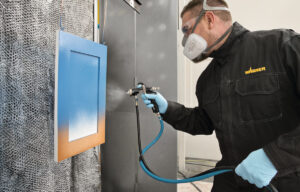 Manual Spray Guns
Operated by individual industrial painters, manual spray guns are used for flexibility and visual quality across varied parts and materials.
Manual spray guns are commonly used in:
- Touch up and rework stations
- Batch or short run production
- Job shops and contract finishing operations
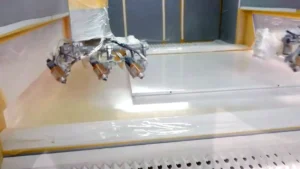 Automatic Spray Guns
Often mounted on reciprocators or robots, automatic spray guns are designed for repeatable, high throughput finishing.
- Automatic spray guns are commonly used in:
- In-line and continuous paint lines
- Robotic and reciprocator based systems
- High volume manufacturing environments
Here to Help You Choose the Right Spray Gun Solution
More than an industrial finishing equipment supplier, ICAFe Companies helps manufacturers:
- Evaluate coating materials, finish requirements, and production goals
- Match applicator technology to part geometry, throughput, and quality expectations
- Integrate spray guns with pumps, controls, booths, and automation
- Support installation, training, optimization, and long‑term service
This approach reduces risk and ensures your spray gun technology delivers the right results.
FAQs about Industrial Spray Guns.
ICAFe application experts answer frequently asked questions about industrial spray guns.
Manual spray guns are operated by an individual painter, while automatic guns are mounted on machines, reciprocators, or robots. The underlying spray technology may be the same, but automation improves repeatability, throughput, and consistency.
Key factors include coating type and viscosity, finish quality requirements, part geometry, production speed, and whether the application is manual or automated. Another factor worth considering involves environmental compliance.
Different spray gun technologies influence coating transfer efficiency and airborne emissions (overspray). Such factors can affect volatile organic compound (VOC) levels that relate to air quality permit or environmental requirements.*
Selecting spray gun solutions that support both production goals and environmental considerations helps reduce operational risk and supports long‑term compliance.
*Environmental and air permit requirements vary by location and application.
Manufacturers often select technologies such as HVLP air spray, air‑assisted airless, or electrostatic spray guns to improve transfer efficiency and reduce overspray. However, spray gun selection alone is not enough.
Proper system setup is essential to reducing paint waste and overspray. Fluid supply design, pressure control, and spray gun adjustment work together to improve transfer efficiency, reduce VOC emissions and support sustainability goals.*
*Environmental and air permit requirements vary by location and application.
Inconsistent pressure, pulsation, or material delivery can disrupt atomization and compromise finish quality. To perform reliably, spray guns must be supported by properly designed fluid supply systems that deliver stable, consistent material flow.
ICAFe supports everything from individual spray gun upgrades to full paint line expansions, helping manufacturers evaluate new technologies while protecting existing infrastructure investments.
Liquid finishing operations rely on ICAFe engineers and technicians for:
- Application expertise: Deep understanding of coating behavior and application methods that deliver consistent, high‑quality finishes
- Process improvement: Proven experience reducing material waste, improving transfer efficiency, and eliminating production bottlenecks
- Full lifecycle support: Ongoing support beyond installation, from setup and calibration to training, troubleshooting, and long‑term maintenance
Request a Quote
ICAFe Companies helps manufacturers evaluate, integrate, and support spray gun solutions as part of complete liquid coating systems. This ensures that spray guns, fluid delivery, controls, and operators all work together reliably.
Tell us about your industrial finishing goals. Our experts will recommend solutions that produce consistent, quality results.
"*" indicates required fields