True Blue Troubleshooting
A leading equipment manufacturer prides itself on true blue reliability, but the blue coating that protected its products was not measuring up. Convinced switching from high volume low pressure (HVLP) spraying to a new electrostatic system would help, the finishing engineer reached out to Steve Thomas, engineering project manager with SenecaFTI, part of ICAFe Companies.
“I don’t know if electrostatics are what you really want,” replied Thomas, who brought in the technical sales and process support expertise of Bill Tyler and Ian Skoglund to help troubleshoot on-site.
The finishing engineer thought electrostatics could reduce the abundance of overspray in the messy spray booth, “but Steve knew from experience that air-assisted airless would be a better fit — and easier to implement,” recalls Skoglund.
Electrostatics vs. Air-Assisted Airless
Electrostatic systems can be complex and costly, requiring correct grounding of all electrically conductive objects. Improving the existing HVLP setup with air-assisted airless technology could be simpler and more cost-effective.
Choosing air-assisted airless over electrostatics also ensured coverage on complex geometries.
Pointing out the deep fins and crevices in the products being painted, Thomas said, “There’s just a lot of things that could be missed with electrostatics.”
More Efficiency with Less Equipment
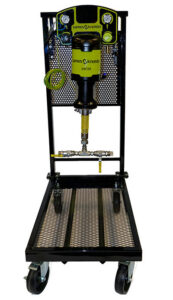
The new setup includes a Sames Airmix® paint pump with the ability to manage two Airmix Xcite®+ manual spray guns.
The manufacturer’s two spray booths were fed by four pressure pots, two outside of each booth, to accommodate two colors: blue and grey. When Thomas and Skoglund adjusted the setup for air-assisted airless spraying, they also reduced equipment clutter.“Instead of having four individual pumps, we supplied both booths with two pumps,” explains Skoglund. “One pump sprays the blue to both booths, and then the other pump sprays the grey to both booths.”
The most noticeable improvements came with the spray gun adjustments that kept the material velocity from going too fast and over atomizing the paint.
“Before, the coating looked muted, almost matte,” says Skoglund. “After we optimized the setup, the finish came out glossy and clean. It was a clear visual upgrade.”
Quick Tips for Air-Assisted Airless Spraying Success
The clear visual upgrade reinforced the importance of correct setup and maintenance of air-assisted airless spraying equipment.
“When correctly set up, air-assisted airless spraying gives a durable, sleek finish,” says Skoglund. The technical sales and process support manager shares how to set up air-assisted airless spraying for success:
- Check fluid pressure. It should be high enough for proper atomization but not excessive, which can cause overspray.
- Adjust air pressure for pattern control. Start low and increase gradually until you achieve a smooth, even fan pattern.
- Verify tip size and condition. Making sure the tip is sized for your coating and is not worn out avoids distorted spray patterns.
- Maintain proper gun-to-part distance. Keeping 8 to 12 inches from the surface usually works well for good transfer efficiency.
- Keep the gun perpendicular and move at a consistent speed for uniform coverage.
- Check for air leaks and hose integrity. Regularly inspecting all connections and hoses prevents pressure loss.
- Balance fluid and air pressures together to minimize orange peel and achieve a smooth finish.
- Flush and clean after use. Proper cleaning prevents tip clogging and ensures consistent quality.
References: Graco, Air Assist (AA) Guns: Spray Pattern Troubleshooting; Graco, 3A8099, PerformAA Spray Guns, Instructions-Parts; Occupational Safety and Health Administration, 1926.66 - Criteria for design and construction of spray booths; Sames North America, Airmix® spray technology
Connect with Industrial Liquid Finishing Experts
We’re here to help troubleshoot challenges and implement solutions that continually improve factory paint line processes and results.