Automation and robotics continually transform factory production and industrial finishing processes.
- Power and force limiting (PFL) robots – also known as cobots or collaborative robots – combine advanced safety with flexibility to meet dynamic production needs.
- Industrial robots deliver high-volume efficiency with consistent first-class results.
Choosing the right strategy remains crucial for factory managers and engineers. To help guide decision making, Hope Dollarhide, paint robot sales engineer at First Choice Robotics, shares practical insights.
Cobots or PFL Robots = Quick Setup and Flexibility
The technology many still call “cobots” or “collaborative robots” has been redefined by ISO (International Organization for Standardization) 10218-2:2025 safety requirements as power and force limiting (PFL) robots.
“PFL robots have a built-in ability to sense and respond to contact. They work safely with people and can be programmed in minutes,” says Dollarhide.
“They’re perfect for environments with frequent color changes or short production runs. Intuitive programming tools make them accessible for teams with limited robotics experience.”
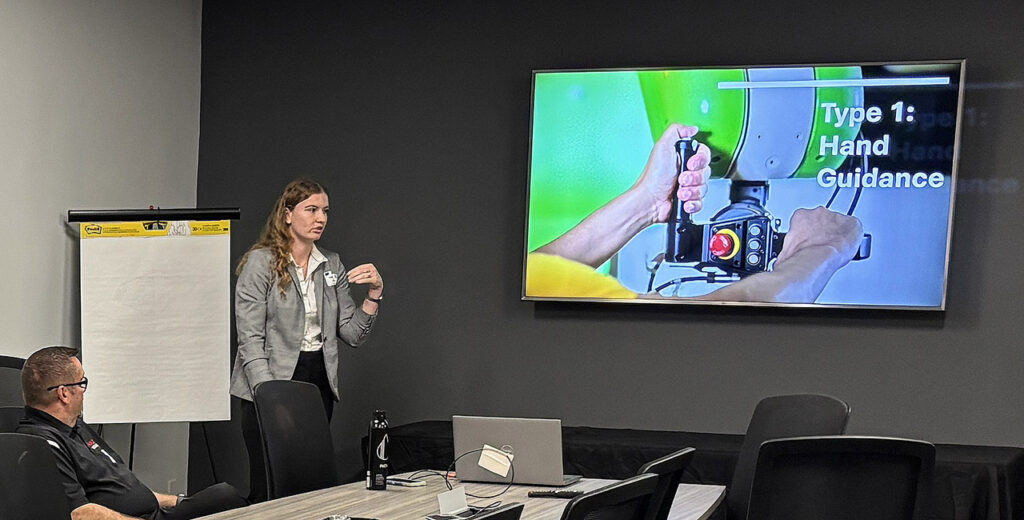
Hope Dollarhide, paint robot sales engineer at First Choice Robotics, shows how a FANUC CRX robot collaborates with industrial painters and fits within factory paint and powder coating setups. First Choice Robotics collaborates with integrators like Dove Equipment, part of ICAFe Companies, to deliver automation to manufacturers throughout the United States and Mexico.
Breakthroughs like the FANUC CRX-10iA/L Paint are making automation accessible to more industrial paint and powder coating operations. The explosion-proof PFL robot offers easy programming with OSHA’s Nationally Recognized Testing Laboratory (NRTL) seal of approval for hazardous environments.
“Due to safety limits, PFL robots operate at slower speeds,” adds Dollarhide, “so they’re not the best fit for high-volume, high-speed environments.
Industrial Robots = Speed and Efficiency
When throughput and finish quality matter most, industrial robots dominate. They excel in large-scale production, where every second counts.
Offline programming lessens downtime during setup. Advanced features can reduce material waste, while enabling fast color changes.
“Industrial robots deliver unmatched speed and efficiency for large-scale production,” says Dollarhide. “If your factory runs continuous operations with conveyors and turntables, these systems provide the cycle times and material savings that keep you competitive.”
Chris Sparks from FANUC America explains when manufacturers would use an industrial robot like the FANUC P50 on their factory paint lines or spray booths. Sparks works with Dove Equipment, part of ICAFe Companies, to identify and integrate industrial finishing automation solutions in factories throughout the United States and Mexico.
Hybrid Approach = Fast Production and Flexible Deployment
Some manufacturers are blending PLC robot flexibility with industrial robot speed by adding safety measures like fencing and e-stops.
This hybrid approach offers the best of both worlds: fast production and adaptable deployment.
PFL Robots vs. Industrial Robots vs. Hybrid
“To determine which robot is the right fit, start by asking, ‘What really matters most in your application?’” says Dollarhide. The paint robot sales engineer advises manufacturers to define their goals first.
This quick side-by-side comparison can help prioritize what matters most:
| Feature | PFL robots | Industrial robots | Hybrid approach |
|---|---|---|---|
| Speed | Safety-limited | Fastest cycle times | High speed with added safety measures |
| Programming | Minutes, intuitive tools | Requires skilled programmers | Mix of intuitive and advanced methods |
| Flexibility | High (ideal for variability) | Low (optimized for repeat tasks) | Moderate (with safeguards) |
| Safety | Built-in, collaborates with humans | Requires fencing and guarding | Adaptable with PFL features |
| Best for | Short runs, frequent changes | High-volume, continuous production | Operations needing speed and flexibility |
Maintenance and Training = The Best Future and ROI
Whether you choose between PFL robots and industrial robots, or take a hybrid approach, Dollarhide considers preventive maintenance and team training crucial to the future of industrial automation.
“The future is really about how well you’re going to maintain your equipment and train your team,” says the paint robot sales engineer. “Well-maintained robots can last decades, and teams that take ownership see the best ROI.”
For the best return on investment in automation, manufacturers also need to keep their “finger on the pulse of what new technologies out there and how to constantly improve automation,” says Dollarhide.
“Yet, the future is about how well you take care of your equipment.”
Contact Industrial Automation Experts
Partner with ICAFe Companies to design, integrate, and support industrial finishing automation solutions tailored to your production demands.
Contact us to get started or to explore finishing equipment solutions.
References: International Organization for Standardization, ISO 10218-2:2025, Robotics safety requirements, Part 2: Industrial robot applications and robot cells, FANUC America, New CRX-10iA/L Paint: World’s First Global Ex-Proof Collaborative Paint Robot, Occupational Safety and Health Administration (OSHA), Nationally Recognized Testing Laboratory Program, Types of Products Requiring NRTL Approval